Harry Styles, Teen Girls, and Critical Reception
April 21, 2017
Harry Styles makes more or less the same argument as @badcoverversion on this point https://t.co/3MSOVYPd3y
— Robin James (@doctaj) April 18, 2017
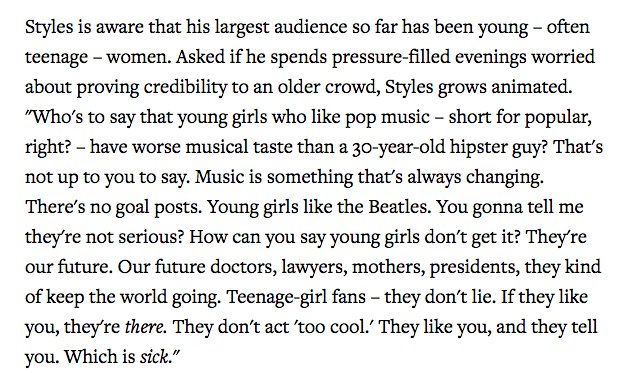
My kink is Harry Styles respecting teen girls and their pure unironic enjoyment of things, thank u. pic.twitter.com/pY9GZYQWeQ
— katherine speller (@Kathriller) April 18, 2017
Oh, hi! Earlier this week, Robin James noted on Twitter that I’ve argued the same thing that Harry did in this quote. And she’s right!
At the risk of being so self-centered that I hawk my most-popular blog entry not about adjuncting again, I want to revisit this topic. Obviously, I still believe that teen girls receive unfair attacks for their taste in books, music, and film, and it’s especially true in the Age of Trump. (Just a few weeks ago, plenty of people were comparing Trump to a capricious, mean 13-year-old girl. This is both unfair to teen girls and an underestimation of Trump’s overwhelming, malignant ignorance.)
But rather than rehash my (or Harry’s) arguments about teen girls—who are awesome, and who do love unironically—I want to shine a spotlight on Harry Styles in the present moment, because it’s part of a familiar trajectory in pop music history.
You might have a singer popular with girls, who knows how to address that audience. Or a group of slightly retro singers who merge the pop of today with the rock of yesteryear into something that drives a stadium of girls to deafening screams. (FYI that Beatles link makes me want to punch the author.) Or a boy band manufactured from somewhat talented constituent parts, all of whom can dance, sing, and maybe act a little. Or a family of musicians, with one super talented front kid. Or a band of guys in their twenties who inexplicably appeal to teen girls despite cryptic lyrics about the union of the snake and wearing more makeup than an experimental Sephora employee trying to shock her customers. Or a synth pop band with foppish haircuts and a penchant for silly bondage gear. Or another boy band manufactured from somewhat talented constituent parts, all of whom can dance, sing, and maybe act a little. Or another. Or another.[1]
And girls love those guys! (I’m deliberately leaving female performers out of this equation, because, hello, different ballgame.) Critics, on the whole, do not–or, if they do, it’s only begrudgingly. Click on some of those links above, and you’ll see what I mean.
But then something happens. Time passes, and the boys in the band grow from fresh-faced to bearded and develop songs that delve into “serious” topics, or at least more adult ones. The Beatles, so the narrative goes, smoked some pot with Bob Dylan and started writing folkier things, and thus became the first boy band to cross the pop boundary into more critically accepted territory. Depeche Mode hooked up with artsy photographer Anton Corbijn, and suddenly critics noticed Violator was a good album (actually, not suddenly: I still remember Chuck Eddy’s scathing review in Rolling Stone, which critiqued the band’s audience more than the music itself.) But that album became a tipping point, and the band acknowledged that Corbijn’s photography and videos led to them being taken more seriously.[2] Duran Duran worked with Nile Rogers on Notorious. Justin Timberlake worked with Timbaland on FutureSex/LoveSounds.[3]
But what all of these have in common is the idea that the music that the boys made previously lacked seriousness because it appealed to teen girls. Most boy bands grow up by shifting toward genres associated with male audiences. But even if the music itself does not change dramatically (e.g. Depeche Mode), the connection to other, more critically lauded males allows the boy band to become grown up and a serious contender for male listeners.
And while Harry Styles gets his audience of teen girls, he’s–sigh–still doing the same thing as his musical predecessors. For example, an article in Forbes about his new single, “Sign of the Times,” specifically highlights the rock direction of the song as a sign of a “true artist”:
I do love that Harry Styles stuck up for his audience of teen girls, and I’m all for him making whatever kind of music he wants. But it’s important to understand that even though Harry Styles loves his teen audiences, he’s going down a familiar path where critics will still shit on that audience.
[1]In these last three examples, I’m talking about NKOTB, Backstreet Boys, and *NSync, but only one member (Justin Timberlake) of these three really has the critical leap that I’m talking about.
[2]I will add this citation later, when I’m at home. It’s from a Depeche Mode book I don’t have access to at the moment!
[3] I could write a whole other blog post about white male former teen idols working with black producers to gain credibility.
Sleater-Kinney’s Dig Me Out, 20 Years On
April 13, 2017
Sleater-Kinney’s Dig Me Out changed the course of my life.
During the summer of 1997, I was an intern at Rolling Stone through the American Society of Magazine editors. The ASME program seemed great–two and a half months of paid work at a magazine, with promises of clips at the end. I was thrilled first to be accepted into the program, and then ecstatic to be matched with Rolling Stone. Everything was coming up Elizabeth!
Except it wasn’t. It turned out that Rolling Stone was the only magazine in the program that didn’t allow its ASME interns to write anything. And then the editorial assistant started a class war between me and the other interns at Rolling Stone by mentioning casually I was getting paid, while they weren’t. And then I attended an editorial meeting where someone called Gwen Stefani “fat.” And then I got stuck in the research department with little to do, and only 1997 internet.
I spent my days feeling isolated and like my life’s dream was crashing down around me because I was utterly failing to impress people who didn’t notice my existence. So one afternoon, I skipped out of interning early and did the only thing that would make me feel better: I went CD shopping.
Somewhere on St. Mark’s Place, I picked up Sleater-Kinney’s Dig Me Out, which had been released two months earlier. I’d never actually heard them before that moment. I’d only read a few reviews—Ann Powers’ in Spin, probably others—and read an article (though not the notorious Spin profile that outed Carrie and Corin as a former couple). They were feminist, a major point in their favor, since my internship kept feeling more and more sexist. I’d heard people around Rolling Stone describe them as “grown-up” riot grrrl, which felt equal parts condescending and intriguing. The final factor in my immediate decision to purchase was the cover of Dig Me Out. The members of Sleater-Kinney looked dorky-cool, and not too far off from the way I dressed.
Back in the dorm, I put Dig Me Out into my Discman, headphones on. The opening guitar riff of the title track sounded like nothing I expected: propulsive, crunchy, and catchy almost despite itself. It relied on none of the old, tired tropes of punk or blues hooks, instead pushing forward with an almost linear urgency closer to post-punk but far more powerful.
A cool riff alone might have drawn my attention, but “Dig Me Out” (again, just the song—we’ll get to the rest of the album in a second) set up the Sleater-Kinney formula. A second guitar joined the other, buzzing up and down and around the lead. That second guitar defied the easy description as “rhythm” guitar. Instead, it established a counter melody that pushed the lead. Finally, more than support, the drums formed the third leg of the trio, sophisticated and powerful at times and restrained at others with perfect instinct.
And above it all was Corin Tucker’s voice, a buzzsaw of perfection in the sense that her voice could cut through any musical texture with precision. She could project, damn it.
This band I’d taken a chance on was fucking amazing. They didn’t sound like anyone else I listened to. They weren’t derivative of anyone! I hadn’t wasted my tiny intern income on a crap album!
And then I listened to “One More Hour.” A lot of rock journalists at the time buzzed about the lyrics, which concerned the end of a same-sex relationship, in a way that felt a little gross and crossed from “this is progressive to talk about” into “let’s fetishize lesbians.” (Again, it was 1997.) It might have been Corin Tucker’s voice, which sounded on the edge of despair, or it might have been that the song perfectly explored the end of a relationship, but although I wasn’t in a relationship with a girl, I felt that song. Before heading to New York, I’d been mired in an “Are we friends or are we dating?” thing with a guy friend, and, at the same time, I felt like I was losing my best friend to her new boyfriend, with whom she spent every waking (and sleeping) moment. Because I didn’t have her wise counsel to rely on, I ended up spending even more time with the problematic guy, and everything exploded in a big mess.
By the time I got to the catchier, less-heavy songs on the album–”Words and Guitar,” “Little Babies,” and “Dance Song ‘97”–I welcomed the emotional respite. “Words and Guitar” gave me a different kind of inspiration, though. As one of Sleater-Kinney’s meta-rock songs (as in, it’s a rock song about rock music), “Words and Guitar” carved out a place where women could make music and they didn’t have to sound exactly like dude-bands, but they could also be technically proficient and original.
It made sense with my feelings about my internship at Rolling Stone, too. It became clear to me over that summer that I did not fit in the standard shape of “rock journalist,” or even “rock critic.” And if Sleater-Kinney didn’t try to change their music to be something more mainstream, I could find a place where I wouldn’t have to change myself in order to write about music.
Of course, I’m still looking for that place.
“Four years on, I still can’t look at the new fiction tables in Waterstones; they make me feel like an infertile woman at a baby shower. I feel pity and scorn for people with dreams.”
—Anonymous, “What I’m Really Thinking: The Failed Novelist”
I’m a failed novelist. I’m also a woman who underwent two years of fertility treatments, with the cause of infertility still unknown. And I’m here to tell you that, hoo-boy, I lost my shit on Twitter when I read those two sentences back-to-back. And I will probably lose my shit here, too, but I want to do so in a more coherent way that unpacks the problems with those two sentences being next to each other.
Anyway, we’ll get back to that in a minute. First, I want to situate my “failure”: I’m a failure in the sense that I have not published any fiction, but I don’t consider it a permanent state. But I do understand the author’s state of mind, because I have failed at many things: I failed to be a concert flutist (thanks, cubital tunnel!). I failed in my career in academia entirely. I failed to get good funding for my dissertation fieldwork. I failed to get “with distinction” from my committee for my dissertation in a two-year stretch when everyone in my program else did. I failed get my favorite academic piece published. I failed to get a tenure-track job, and, in the biggest sign of failure in academia, I slipped onto the dreaded “adjunct track.” I failed to get a career in an academia-adjacent field. Later, I failed for a long time to get a literary agent. I failed to get an offer on my book after a major publisher asked for an extensive R&R that I thought I nailed.
And I understand that rejection can put you (or, at least me) into a spiral of self-loathing, self-pity, and self-doubt. I understand crushing moments of defeat, like when I got a letter about a grant that said, “You are not a winner.” Thanks, terrible rejection-letter writer! I understand feeling like nothing will ever work out, no matter what I do. I understand the whining, self-pity into which Anonymous dives (“But… but… I deserve this! It. Is. My. DESTINY!“)
However, I don’t let “failure” define me. Instead, once I get over my crappy mood, I usually see the other side of it. I’ve also had many successes, which I do not let my thoughts of failure obscure: I have an amazing husband. I have great friends. I won awards for my writing, and they were for the pieces I cared most about. I hold the PhD from a well-respected program at an Ivy League university. I wrote about things and people that meant the world to me. I used my writing about being an adjunct to help others. I got paid to write about my career transition out of academia. I now have a great job unrelated to academia. I am debt free. I have a literary agent. I have a book out on sub.
Now that we’ve established that I’m a “failure” (rather than an actual failure), I want to come back to my main “losing my shit” critique. My first reaction upon reading those two sentences was: JESUS FUCKING CHRIST YOU DO NOT DESERVE A CAREER, YOU CALLOUS ASSHOLE. My second was: maybe this author needs to work on empathy. It would certainly help her writing.
Now that I’ve gotten my own inner asshole on the page, let’s look a little more closely at those two sentences, and why they are so terrible.
The first one minimizes infertility. A book, no matter how much it means to you, is not a baby, nor is difficulty publishing the same as infertility treatment. You may find some parallels–even I do–but it takes a real lack of empathy to assume that they hold the same magnitude of feeling. And then, the kicker. Due to the parallel “I feel” construction, the second sentence ascribes fucked-up emotions to infertile women, “pity” and “scorn” for others (Presumably those who are going to have babies?).
As a woman going through infertility treatments, I felt a lot of things. Anger was second from the top: at my body, for not behaving the way I thought it should; at doctors, who couldn’t explain why I was only randomly ovulating, or why my estrogen levels weren’t rising when they should have, or why the fertility drugs failed to work sometimes; at people who would ask me rude questions (including “So, are you knocked up yet?”) when they heard I was doing IVF; at the fertility program’s social worker (!!!) who belittled my dismay at a failed cycle, telling me not to “bemoan” my situation.
And, yes, I was occasionally jealous of friends who had no problems getting pregnant. Or annoyed with people who pried too hard when I didn’t want to talk. Or upset that my clothes no longer fit. Or moody from my fertility drugs. Or anguished at the unfairness of it all.
But you know the overwhelming emotion? It was sorrow. A deep, wounding, chasmic sorrow that cut through me every time a cycle failed or my ovaries didn’t respond or that stupid social worker made another insensitive remark or someone asked if I was pregnant because, damn it, I certainly looked like it during the fertility treatments. That sorrow ached with the closing of possibilities, of roads that could not and would not be taken, of things that will never happen, not because you don’t dearly want them, but because they are not possible for you.[1]
The connection of an infertile woman’s feelings to “pity” or “scorn”–the two emotions, by the way, that I never felt about a baby shower or my friends’ kids, because I love my friends and their kids, and I’m not an asshole–reduces that sorrow into mere bitterness. It reinforces gross cultural assumptions about women with fertility issues, that our barren uteruses and tired, shriveled ovaries leave us old hags on the sidelines, unloved and unloving.
Finally, as I said above, it lacks empathy. My suggestion to the author–and I am being far more charitable here than the “Fuuuuuccckkk youuuuu” that I uttered on Twitter–is that she needs to work on this facet of understanding humanity, both for her life and for her work. Empathy is one element of good writing, but is essential to good living and to being a good person. Some writers can get away with an underdeveloped sense of empathy in their fiction *cough* Jonathan Franzen *cough*, but as a human, its lack is detrimental *cough* Jonathan Franzen *cough.*
[1]Several years out from my experience with infertility, I have some perspective and have gone through the grief process. I don’t think that the path for us to add to our family is via my uterus, and that’s all right with me. My husband and I are in the early stages of adopting. It’s going to be challenging, and also rely on chance, as someone has to pick us as parents.
Female Friendships on Film (We Need More)
April 3, 2017
My boyfriend’s hand hovered menacingly near the small, red alarm clock on my dresser.
No, he was not trying to hit snooze. Or check the time. Or anything one might normally do with a clock while waiting for someone to unpack their books before heading out to dinner.
“Who is this?” he asked, pushing the alarm clock toward me. I dropped my backpack to the floor to grab the clock from him before it fell to the ground.
I laughed. Not hah-hah, but uncomfortably. “It’s Ewan McGregor. You know, the guy from Trainspotting. K. got it for me.”
During a summer internship in NYC a few years earlier, my friend K. and I bonded over journalism, finding the cheapest restaurants in the city, and Ewan McGregor. K. and I had other things in common, including a bunch of mutual friends in New Orleans, where she’d grown up and where I went to college. But somehow Ewan McGregor rose to the top of our list of occupations. Hence the clock.
My boyfriend placed the clock back on the dresser, and some of the tension left his hand as he realized I did not have a chance with the handsome, married Scottish actor and so he had nothing to worry about.
“You two are so juvenile. And weird. Let’s go eat.”
Suddenly, the conversation ended. He didn’t want to talk about K., and I was just glad that Ewan McClock had escaped unscathed.
More than fifteen years later, I refuse to believe that I’m weird or juvenile compared to a guy who felt threatened by an alarm clock. But back then, instead of anger or disbelief, I only felt relief that he dropped the topic and not the clock. Sure, he was also jealous of the time I spent with K., but our friendship didn’t threaten his masculinity like a hot Scot on a clock did.
***
The incident did teach me something, though. Many men have no interest in women’s friendships. My terrible ex-boyfriend may have been an extreme example, but plenty of other men and boys have the same reaction: a zoning out, a changing of the subject, a dismissal of female friendships as less interesting than their own exploits. Women are into shopping and gossip, amirite?[1]
And while men get their own gross characterizations—that their relationships are mono-syllabic, sports-oriented affairs—a large swath of pop culture counters that Totino’s Pizza Rolls version of life. The films of Judd Apatow (and his circle of protégées) created a comedic style where men’s friendships, humorous but spiked with real emotions, became central to the plot.[2]
The backlash against Ghostbusters (2016), or statistics that point to the lack of speaking roles for women in mainstream Hollywood movies, or the fact that the Bechdel Test even exists all point toward a Hollywood culture disinterested in female friendships. And while there are exceptions to every rule, the overall picture (drawing again on the statistics at that link above) is one where women’s activities are for women, while men’s are for everyone.
***
So, as I watched T2: Trainspotting, all I could think was, “They would never make this film about a group of women.” T2: Trainspotting is all about friendship—fucked up friendships between men, mending friendships in middle age, and figuring out what you’re going to do with life when maybe it has already passed by.
In Trainspotting, the central relationship was with heroin. Friendship—and Renton’s crush on Diane (Kelly McDonald)—fell in line behind heroin. Without heroin (though it’s always in the background, especially for Spud), the focus sharpens on Renton’s big rip-off at the end of Trainspotting and he betrayal his friends felt as a result: Spud, whose addiction to heroin defined his life; Sick Boy, who blames his failure in life on Renton; and Begbie, who wants revenge.
Surprisingly, the film works better than it ever should. A sequel to a zeitgeist-infused film like Trainspotting could easily turn into a giant dumpster fire. (In fact, one could say that Irvine Welsh’s 2002 sequel, Porno, is at least a small dumpster fire.)
But in the past 20 years, the cast of Trainspotting have grown as actors, and their performances in T2 build on the flaws as well as the redeeming qualities of the characters. Renton is still a little smug, but brought down by the breakup of his marriage. Sick Boy reeks of failure, but also a strange ability to forgive even when he doesn’t want to. Spud has his addiction, but his still sweet personality remains. And Begbie—well, Begbie is a monster, but Robert Carlyle is so fantastic at nuanced monsters.
***
T2 features middle-aged men, all of them huge fuck-ups in their own individual way, but all—even Begbie!—sympathetic and human despite those fuckups (or even homicidal tendencies). They are pathetic; they are failures; their wrinkles are on full display.
Women in movies don’t get to age. Renton’s former underage girlfriend Diane makes a cameo appearance when Sick Boy needs a lawyer. Renton visits Diane with Veronika (Anjela Nedyalkova), a prostitute in her 20s most accurately described as Sick Boy’s business girlfriend. As he leaves, Diane tells Renton that “she’s too young for you.”
Diane looks frumpy and old, a bossy, serious version of the school girl who once blackmailed Renton into sleeping with her a second time.
Diane vanishes from the film, aside from one glance before Renton launches into T2’s version of the “choose life” speech, and Renton ends up sleeping with Veronika.
It’s a real possibility, I suppose. Lots of women in their 20s sleep with middle-aged dudes, especially when they think they can get something out of them.
***
They won’t make this film about women, because they can’t make this film about women. I loved T2 and its flawed group of friends, but there’s another huge problem (or rather, series of problems) with making a film as nuanced about female friendship.
The first is that no female version of Trainspotting exists. Trainspotting captured the zeitgeist both in story and in its soundtrack; T2 uniquely takes the characters and actors from the first film and meets up with them 20 years later. As of now, no female-oriented film provides an equivalent group of fucked-up characters who somehow manage to be compelling.[3]
But even if there were a source film, the further complication of age arises. In a large study of Hollywood scripts, women spoke fewer and fewer words (that is, they had fewer opportunities and smaller roles) in movies as they age. The inverse was true for men.
If a film about a fucked-up group of women were made today, and became a film about friendship 20 years later, what would it look like? And what are the odds that it would be able to keep the cast from one film to the next?
[1] Television—rather than film—has recently been a place to illustrate more complex female relationships. From Orange Is the New Black to Big Little Lies, women have greater and more complex representation on prestige TV than most anywhere else.
[2] It’s not surprising that Apatow produced Bridesmaids, one of the few films about female friendships in recent years, or that Ghostbusters drew on some of the same cast.
[3] Again, there’s a disparity between television and film. For example, both Sex and the City and Absolutely Fabulous revisited their characters in film after several years’ absence, but they did not originate as movies.
Jarvis Cocker & Chilly Gonzales, Room 29
March 28, 2017
 It’s been a little over a week since Jarvis Cocker & Chilly Gonzales released Room 29, a song cycle of tales from the Chateau Marmont, and I’m still searching for a
review that deals with something other than Jarvis’s lyrics, or that reduces the piano’s sound to “tinkling.”1
I hate to be one of those (former) musicologists who bemoans the lack of music education among pop music reviewers. That old, stale argument is the masculine posturing
of a mindset that says, yes, the only real way to discuss music’s merit requires formal analysis of harmony, with maybe a nod to “surface” details like melody and timbre. I hate that attitude, and not because I’m not into harmonic analysis.2 Instead, I hate it because it reduces music to “the notes,” when it’s about so much more: expression, merging of sound and lyrics, timbre, production values, etc.
But while I do think reviewers can and should apply different values to different projects, it’s a GIANT FUCKING PROBLEM that reviewers have paid so little attention to the music of Room 29, and the song cycle form it takes. These two aspects provide keys to understanding how Room 29 works, and whether, for that matter, it succeeds. But it’s also troublesome that reviewers have slighted Chilly Gonzales, whose music creates the mood for Room 29, in favor of measuring the project on whether Jarvis’s lyrics about the sad, dead residents of the Chateau Marmont stand up to his keen observations of British life.
So, here I am, being a cranky musicologist, but endeavoring not to be one of the masculine smackdown versions, and insisting that this is a song cycle, and you have to consider the music, people. This does not mean using complicated jargon, or analysis that only music theorists understand. Instead, it means having a fundamental grasp of what this thing (that is, a song cycle) is and how to evaluate it, and, yes, paying attention to sound.
By calling Room 29 a song cycle, Gonzales and Cocker are placing their music a tradition that flourished in 19th-century Romanticism and emerged from its values. When constructing a song cycle, composers such as Franz Schubert or Robert Schumann focused on the work of one poet; each Lied (or song, if you prefer) would take its form from a preexisting poem; and the whole cycle would be arranged in such a way as to construct a large, emotional arc on a central theme.3
In a recent interview, Gonzales called Room 29 a “reverse song cycle,” meaning that the music came before the lyrics. He would send Jarvis the piano parts, and then Jarvis would compose the melodies and lyrics over them.4 Although composed after the music, the lyrics tell an overarching story and give form to Room 29, just as they would in a traditional song cycle. The title track, which sets up the themes of the album, sets up the ironic distance within this “comfortable venue for a nervous breakdown.” Jarvis observes, “A lifetime of spectating leaves you impotent, unable to join in without a frame of reference, watching the playback after the event.” The songs that follow are “playbacks after the event,” unflinching but also sympathetic portraits of the room’s former inhabitants: “Clara,” the depressing story of Mark Twain’s last surviving child; “Bombshell,” which reflects on the honeymoon of Jean Harlow and her second husband, Paul Bern (who supposedly killed himself due to impotence, but who may have been murdered by a former lover); Howard Hughes, whose life story forms not a song by Jarvis but a narration by historian David Thomson. Other, anonymous characters flit in and out as emblems of (old) Hollywood in “Tearjerker,” “Salome,” and “Ice Cream as Main Course.”
And that’s where most reviewers stop. BUT here’s what I love about this project, and what I think is so smart about it after repeated listens: Gonzales’s music—mostly piano, but also with some additional strings provided by the Kaiser Quartett—draws on the sonic traditions of the 19th century, as well as the classic Hollywood film soundtracks of the earlier 20th century. The songs deliberately evoke a past through the sounds that might be associated with those times: occasional flashes of ragtime through a syncopated rhythm, or fragments that recall something from Great American Songbook, or strings that murmur or swell like something from a 1930s soundtrack to a melodrama.
Room 29 isn’t necessarily inventive in terms of new-classical/pop song cycles (I would listen to Corey Dargel for that), but it is a beautiful illustration of how pop music can use piano and orchestral instruments in an emotional and affecting way. (Note: I am also a huge fan of old Hollywood, so this project automatically appeals to me.) The instrumental “Marmont Overture,” for example, uses rubato, a wandering melody, and lots of harmonic color to set a wistful stage for the sound effects of the Chateau Marmont. Each of these musical aspects alone can evoke uncertainty; put together, it musically predetermines themes to come.
“Bombshell” and “Belle Boy” use rhythm to great effect. “Bombshell” pulses in the treble register of the piano, a right-hand melody that follows Jarvis’s lyrics, but inevitably returns to a ticking time-bomb echoed in the strings. We expect ominous pulsing in the left hand of the piano, and locating it in the right upends expectations in a way that somehow makes the song more unsettling. When the song departs from this texture, through interjections from the strings, it only heightens the feeling the something ominous will happen. The lyrics—about Jean Harlow and Paul Bern—imply the missed opportunities in their relationships, but, like all good Jarvis lyrics, could be extrapolated out. But with the specificities and the knowledge of Bern’s death two months later, the ominous piano setting becomes a prelude to tragedy.
“Belle Boy” pairs with “Bombshell” in its use of a pedal-point in the piano’s bass note and in the strings. Here, the music gives the sense of the bell boy rushing through his duties, having to deal with all kinds of depraved jerks in the process. (It’s a little over-the-top, though, when an actual bell chimes. Who does Chilly Gonzales think he is, Hector Berlioz?)
While other songs in the cycle mix 20th-century styles, “Howard Hughes Under the Microscope” draws on Debussy. The impressionistic harmonic palette (some parallel chords here and there, harmonies that feel more about color than direction, etc.) allows David Thomson’s narration to achieve focus and adds a mood of wistfulness to Thomson’s description of Hughes, both as the Hollywood rich kid and the later, urine-sipping version.
With sweeping strings, “A Trick of the Light” brilliantly summarizes Hollywood glitz in general, and golden-age Hollywood. This song best illustrates how Jarvis and Chilly Gonzales weave the themes of the album into sophisticated and emotionally resonant music. Arpeggiated chords lead to deliberate rests, giving a feeling of uncertainty, as its musical direction swells and ebbs. The lyrics are about Hollywood, of course, but become so much more through Jarvis’s performance within the song, which builds to desperation. The lyrics could easily become melodrama, and so could the music (it ends with a sweeping orchestral section that would not feel out of place in an early talkie Oscar-bait film), but Jarvis and Gonzales manage to escape that fate (or maybe just do melodrama so well that I’m willing to forgive them for it).
“A Trick of the Light” also illustrates a final point about Room 29 as a song cycle. It comes late in the album’s order, after so many of the other songs have already illustrated the parts of the whole. It works as a grand summation and an expansion at the same time, just like a song late in a song cycle could.
- FFS, people, that’s just lazy.
- I’m a flutist and bassist who thinks of the world in single-line melodies as they intersect, not as simultaneous chordal things. I’m great with polyphony, y’all!
- For example, one of the quintessential song cycles of the 19th century, Robert Schumann’s Dichterliebe, creates an overarching narrative from a series of Heinrich Heine’s poems: the poet finds love, then loses it. This arc illustrates the Romantic mindset, in which pure happiness could not be understood without the deepest sorrow to frame it; sweet needs bitter to make sure it keeps from cloying; and true beauty cannot exist without the ugly (or even monstrous). Also, Heine haaaated being called a Romantic, and yet he’s recognized as one of ‘em, thus proving that the Romantics were the first hipsters. (Sorry.)
- I wish the interviewer had delved deeper into this. Chilly Gonzales implies it wasn’t really too back-and-forth (at least not at first), but that seems extra weird to me as a person who’s been in bands.
Depeche Mode: Spirit
March 19, 2017
“Oh, we’re fucked.”
–“Fail,” from Depeche Mode’s Spirit
It takes a lot to get Depeche Mode to write a political album. The band has never exactly done political. Yes, they have a handful of mildly political songs: “Everything Counts,” “People Are People,” and (some say) “Master and Servant” (but do you really believe that, when Martin Gore was going around in leather bondage gear at the time? Yes, it has the lyric, “In bed or in life, it’s all just the same,” but…). But songwriter Martin Gore* typically sticks to a few themes: lust (“Question of Lust”), love (“Somebody”), religious imagery (“Blasphemous Rumours,” “Judas”), more lust (“Lie to Me,” “Behind the Wheel”, “Stripped,” ), lust with religious imagery (“Personal Jesus,” “Black Celebration”), lust with a hint of S&M (“Master and Servant,” “Strangelove”), and the occasional dash of supposedly unintentional homoeroticism (“Never Let Me Down”).
And that is fine. Lust has been valid topic for songwriters throughout pop history, a rich vein to mine in all its permutations (which Gore has). Depeche Mode would not be the same without Gore’s particular take on sex and sexuality; had Vince Clarke never left, the band would be remembered for some catchy, singable synthpop. Pairing Gore’s lyrics with dark, layered synths, Depeche Mode honed a sound–and a legacy–apart from their synthpop peers.
That unique sound drew me into the music. I’ve been a Depeche Mode fan for roughly 27 years now, which puts my arrival as a fan between Music for the Masses and Violator. In retrospect, that pairing marks the band’s high point, the moment when Gore’s sex-tinged lyrics and Alan Wilder’s dense, layered synth melodies fused into something utterly appealing to a semi-goth (goth-adjacent? goth-esque?) tween. Since Wilder’s departure, the band’s sound shifted, becoming more atmospheric and less dance-oriented.
Spirit keeps that atmospheric sound, but Gore’s lyrics have turned political.
I’m not sure how I feel about this. I’m both a pop music scholar** and a Depeche Mode fan. My feelings about this album can’t be separated into neat, little segments, wherein the critic in me knows that the lyrics are lacking even if the fan in me recognizes that the spirit (no pun intended) is willing.
As a pop music scholar at the nexus of pop and politics, I see this shift on Spirit as a signal of things to come: We are fucked, I think (like Gore), if Depeche Mode has finally released a political album 36 years into their career. When bands as large as Depeche Mode, who lived through other times that demanded political action (They were flirting with homoerotic imagery during the height of the AIDS crisis, ffs), now suddenly pay attention, that alone offers a measure of the danger we are in.
Although Gore says he wrote most of the album before the election, the songs throughout the album speak to the need for change and the threats of the present moment. “Going Backwards” laments the detachment of observing modern warfare from afar. “Where’s the Revolution” laments the easy deception of the masses by people like Trump: “C’mon people, you’re letting me down.” “Worst Crime” laments that people are not doing anything: “Once there were solutions/now we have no excuses.” “Poorman” laments the inefficacy of trickle-down economics. “Fail” laments our failure at all of the above.
As a political album, Spirit doesn’t quite rouse the troops so much as express the despair and powerlessness that a lot of people feel, whether about Trump, or war in Syria, or Brexit, or the ill-treatment of immigrants by ICE, or extrajudicial killings of people of color by police. My initial reaction to this despair lacked charity: I got annoyed that Depeche Mode, all very rich dudes, would release an album chiding everyone else for not shaping a revolution to their needs. My second reaction was: I get it, Martin. I have felt this kind of despair and powerlessness at a fairly regular rate since November 8, and I don’t think it’s going to go away no matter how much money I send to good nonprofits, or how much I volunteer at Planned Parenthood, or how often I send letters, emails, and postcards to elected officials.
So, while Spirit may be the political album that expresses how I feel right now, I’m not sure it’s the one I need. It might have been the album I needed a few months ago–just like an album of sad songs does wonders to heal a breakup, an album about political despair would have made for some productive wallowing. But I can’t stay in my pocket of despair for eternity. I need to move on, and I’m not sure Spirit is the album to help me do that.
I will say one final thing for Spirit, though: At least it’s a clear, disavowing response to Richard Spencer, who called Depeche Mode the “official band of the alt-right.”
*The most political song the band has ever released was “The Landscape Is Changing” from Construction Time Again, written by Alan Wilder. As much as I love Alan Wilder and dearly miss his musical contributions, this song is a lyrical stinker.
**You can take the girl out of the academy, but you can’t take the academy out of the girl.
900 Words about Knitting
February 22, 2017
By the time I decided to knit a pussy hat for the Women’s March, there was almost no pink yarn left in NYC, and no time to order any. But there was a half-finished sweater, made of perfect-for-pussy-hats bright fuchsia yarn, that lived, still on needles, in a plastic bag in my cedar chest.
I pulled the sweater from the cedar chest and knew: yes, I could destroy this hideous monster.

Look how adorable! Sigh.
The sweater, from a pattern from Stitch & Bitch Nation, was supposed to be French-inspired, romantic, a pale pink confection combining two different weights of yarn. It was light and floaty on top, and cinched in at the waist with a contrasting ribbon and stretchy ribbing below. It would be perfect to wear to the yarn shop where I worked in my final days of dissertation fieldwork.
If only I had stuck to the pattern. My disaster started when the shop didn’t have the right color yarn. Instead of pale pink, I went with a screaming fuchsia. Then, to show off my yarn-shop maven skillz, I substituted an interesting, cabled lace rib for the simple ribbing. It was a beautiful pattern, and well knitted. Unfortunately, it added the bulk of cable and the bare skin of lace, making sure I was hot AND cold.
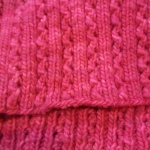
Beautiful, but stupid, cable lace rib
It also added the appearance of a fifteen-pound weight gain on an already bad-relationship-expanded frame. When I put it on, I cried.
At the time, I’d never given up on any knitting project, mostly because I needed them for my job. But I couldn’t see how to make it better. I shoved it into a plastic bag, and worked on some stupid hand warmers so I’d have something new for work that week.
Soon—and I mean over the span of the next two months—I got a dissertation fellowship, was fired from the yarn shop for letting them know about the fellowship, ended the crap relationship, and moved back to New York. The sweater receded in importance. I forgot about fixing the sweater, because I had a dissertation to write.
And now, more than ten years later, I ripped that sucker. Because sometimes the only way to fix something is to turn it into something else.
Of course, I soon encountered another problem: I haven’t knitted in five years. I was no longer the speedy, facile-fingered gal I was in 2005. The first pussy hat I made was too big, because I didn’t check my gauge. It was also a little sloppy, because I kept knitting after 10 pm. And then I completely fucked up Kitchener stitch (don’t ask).

This is what I look like at 11 pm after knitting for too long.
It looked like crap, at least by my “former yarn store worker” standards. But it was done. And I still had time enough to make another for the March.
I started in on the second. I paid more attention to my gauge, as well as my tension in my hands. I made sure I spent a large enough amount of time on it to make progress, but I also reminded myself to quit before I fucked it up. I did the Kitchener stitch finishing while fully awake, for example.
In the end, it’s a pretty good hat. It’s still a little big, but in a way that is cute, instead of bad-‘90s-alt-band. But I’m not embarrassed to wear it.*
Anyway, this post isn’t exactly about knitting, even though it is.
Since the election, I’ve been trying to write, but it’s been nothing but ugly sweaters. I start things, leave them half finished, and when I come back to them, I no longer recognize the thing I wanted the writing to become. They aren’t exactly as terrible as my ugly sweater, but, like that sweater, I don’t see how I can fix them without ripping them apart and starting over, even when they have beautiful parts.
And, some days, I just don’t even see the point in knitting—er, writing. That sweater didn’t seem like a worthy project once I got back to New York and immersed myself in a dissertation about third wave feminist politics and music. Now, my writing feels unimportant in a United States with a narcissistic, sexual predator president whose every cabinet member seems out to destroy the thing they are supposed to protect. Even in areas where I am an expert, I feel unmoored by the speed of everything changing around me: After years in academia, I’m not good at coherent hot takes.
But sometimes you have to do something, even if it means knowing your actions will be inadequate. You might have to destroy a sweater in order to make a functional, sloppy-looking hat. Or get out and wear that hat to a protest, even if you know that the people who need to listen to you believe wackadoo conspiracy theories and think that George Soros is giving you pin money.

The face of a woman who did not get any of that sweet, sweet Soros cash.
And sometimes you need to write a bullshit essay about bad choices in knitting, because you need to start writing again, even if your writing will never be up to the task of reckoning with the contemporary moment.
*There’s much to critique about pussy hats in terms of white feminism, body politics, gender essentialism, and crafting, and why maybe I should be a little embarrassed by the hat. But that would be an entirely different post. In fact, it is similar to a pitch I’m crafting.
Loud Sirens Episode 5: Lauren Oglesby
November 17, 2015
Episode 5 of the Loud Sirens Podcast is up at Libsyn!
This episode’s guest, Lauren Oglesby, is a singer-songwriter from Seattle who now lives in New Orleans. Unlike the previous guests, I’ve never met Lauren in “real life”; instead, she answered my general call on Twitter for women who wanted to be interviewed.
So, in other words, Lauren is pretty brave.
In our first email exchange, Lauren pitched me with an intriguing topic: how contemporary Christian music had influenced her when she was learning to write songs, and how she’d gotten away from that both in terms of faith and songwriting. Now, I know nothing about contemporary Christian music. I was raised Catholic, and the post-Vatican II church music that I grew up with somehow managed to combine the worst attributes of church modes and 1960s folk music. So, of course I wanted to talk with Lauren to learn more about the Protestant side of the world.
Our conversation covers a lot of ground, from her songwriting process to falling in love with music. That little bit about loving music comes toward the end of the podcast, and it’s one of my favorite moments in the series so far. Seriously, it’s great to find someone else who feels the similarities between falling in love with music and falling in love with an actual human.
Lauren is also a tremendously talented musician. You can (and should!) check out her music here.
Loud Sirens Episode 4: Jamie Varriale Velez
November 11, 2015
It’s the “not punk enough” episode of Loud Sirens! RIGHT HERE!!!
Punk is complicated, if only because it’s a subculture with an endless feedback cycle with academia. Was it complicated in the first place, or did Dick Hebdige make it so, and did the thousands of white, middle-class nerds who ended up in grad school after having a teenage punk band reinforce that notion? I dunno! But probably the Hebdige thing, and definitely the last bit.
Anywho, Jamie Varriale Velez and I both feel like we don’t quite measure up to the “punk” identity. Jamie’s analysis along lines of race, ethnicity and gender is both smart and impassioned, and is pretty much what I’d like to think is super punk rock. But we both know that what we’d like punk to be isn’t always what punk is. Ergo, not punk enough.
I first met Jamie at the Willie Mae Rock Camp for Girls, in the summer of 2010 (I think?), through our mutual friend Daphne. We were nerds among the cool kids, in a lot of ways—Daphne and I taught the “Women who Rock” session, which Jamie helped out on. We’ve been pals ever since, commiserating over academia and punk and punk in academia.
And, of course, we’ve talked a lot about our positions as women in relation to both those topics, and this podcast is no different! Jamie’s research on Los Crudos and identity politics in punk pairs well with my research on Riot Grrrl. Or, really, it’s a good study in contrast of the deployment of identity politics—what works, what doesn’t, and how aspects of identity become flattened when those politics involve women. (Like, for example, the erasure of women of color from Riot Grrrl.)
Jamie’s a FANTASTIC, funny, smart partner in conversation, and I’m amazed by her extensive knowledge about punk, including Greg Ginn’s astrological sign (Gemini!), as well as its implications for Black Flag. Who knew? JAMIE!
So, listen to the podcast! We might not feel punk enough, but who really does?
Loud Sirens Update!
October 29, 2015
So, I’ve been having some delays getting the podcast onto iTunes for various dumb reasons, up to and including my own negligence, but also involving weird errors on iTunes for three days straight any time I tried to go to the “Podcast” page. Given that wee hitch, I’m putting a pause on releasing the next episode until I get this shizz straightened out.
BUT! This does not mean that you can’t listen to the three episodes already up at Libsyn! Here’s a little blog post about each episode, so you can check out each of the lovely participants: Meg Wilhoite, Erica Flores, Alexandra Apolloni.
Aaaand, I am also switching to a TUESDAY schedule. I am a keen observer of what gets the most circulation via my Tweets (blog posts and my other writing), and the Thursday release schedule just wasn’t working. I don’t want to do a disservice to any of the amazing women who offered their time to the podcast (so far!), and so I’m going to be putting this podcast out on what is, quite frankly, a better day for getting noticed.
The schedule going forward:
Episode 4: Jamie Varriale Velez (Not Punk Enough!)
Episode 5: Robin James (Postfeminism & Race! Depeche Mode! EDM!*)
Episode 6: Lauren Oglesby (Songwriting! Composing! Escaping CCM!**)
Episode 7: Liana Silva (Sound Studies, Part 1!)
Episode 8: Sammus (Nerdcore! Indie Hip-hop! Sound Studies, Part 2!)
More interviews are in the mix, but I order is still TBD.
*Electronic Dance Music
**Contemporary Christian Music
 Bad Cover Version